First woman to receive Nobel Prize


Radium was discovered by Marie Curie. She is the first woman to receive Nobel Prize.

Marie Curie, daughter of a teacher was born at Warsaw (Poland). After her studies she started her career with Prof. Becquerel the discoverer of radioactivity.

He had left some pieces off uranium in his table drawer. Marie used them to weigh photo plates. When, those photo plates were developed. She saw few lines there and suspected that some rays had emanated from the Uranium.

Marie had marries Pierre Curie, physicist. The couple started conducting experiments on their own. They found abundant Uranium pitchblende in the country of Bohemia. They obtained about 10,000 Kilograms from the government on request.

They extracted "Radium" from it. The radium delivered a strange blue light when it was kept in a test tube in a dark room. Marie curie was awarded the Nobel Prize in chemistry for her work on the isolation of Radium and Polonium.

To honor Marie curie a chemical element 'Curium' and a unit of radioactivity 'Curie' have been named after her.


Read More Add your Comment 0 comments


Father of nuclear physics


Enrico Fermi invented nuclear reactor. He is known as the father of nuclear physics. He discovered the chain reactions.

Fermi was born on September 26, 1901 in Rome. He obtained his PhD degree in the field of X-rays. He made research and discovered that when the element is bombarded by a slow moving neutron, it becomes radio active and starts emitting radiations.

In this process one element changes into the other element. He also discovered that a fundamental particle named neutrino and produced 80 new artificial nuclei by neutron bombardment.

He succeeded in splitting the uranium nuclei by the bombardment of neutrons. He had worked on the controlled chain reactions.

After several years of arduous research and hard work he designed the nuclear reactor in Chicago. In this reactor he generated the energy by nuclear fission.


Read More Add your Comment 0 comments


Origin of vaccination


Edward Jenner was the discoverer of small pox vaccination. Vaccination prevents men from falling sick. Small pox was a very dreaded disease in 18th century and earlier. Cow pox was a milder disease with similar symptoms. It was a disease of cows.

A milkmaid came to Jenner seeking his advice. She told him that she suffered from cow pox. Jenner took some fluid from a cow pox sore on the milk maid's finger. Then he injected it into an eight year old boy who had mild attack of cow pox.

After seven weeks, Jenner took some fluid from the sore of a man suffering from small pox and injected into the arm of the boy. The boy was not affected by small pox germs.

This proved that he had become immune to small pox due to cow pox. Jenner went on collecting cow pox fluid consistently for the formulation of small pox vaccination. Thus the practice of vaccinating for the prevention of small pox became wide spread.

Jenner's vaccinations helped wipeout this harmful disease which prevailed at that time. Vaccinations are injected into our body making its natural defense system to produce antibiotics which kill germs and protects white blood cells that combat that type of infection. If the body in case be invaded by these germs, it would be ready to destroy them immediately.


Read More Add your Comment 0 comments


Wright brothers and aircraft


Wilbur Wright and Orville Wright were brothers born to Milton Wright, a Bishop of Dayton, Ohio USA. One day he brought a toy which spurred the brothers to build to a large sized model of the same so that they could climb on and reach the clouds.

Naturally, the idea was superb. The toy was flying up to the ceiling of the room. It was made of paper, bamboo and cork. A rubber band rotated a propeller and made the toy to fly straight in the air.

Wilbur noticed in his shop where the used to work, a box which had bent edges. He felt that the wings of the flying plane could be made in this form. He thought that wings should be designed in such a way that they could be moved up and down during the flight.

The brothers made a model of a plane in 1899. It was kite shaped. They went to Carolina for conducting its trial. Then for four years they continued the trials.

It was December 17, 1903 Orville Wright made the first controlled successful flight. He took it off from Kill Devil Hill at Kitty Hawk in North Carolina on 12 horse power by plane. It was built by the brothers.

The plane reached a height of 10 feet and covered a distance of 37 meters. The fourth and last flight made by Wilbur flied a distance of 850 feet in 60 seconds. But a gust of air crushed it.

However Wilbur made many flights up to a height of 91 meter. He died in 1912. Orville continued his work and made 57 flights. On his self built plane he reached a height of 27 meters.

He lived till 1947 when the flying machine or aircraft had already started flying at supersonic speeds. Today we travel in aero planes to long distances with comfort at the speed of the sound .

These two inventors are remembered as the Wright Brothers.


Read More Add your Comment 0 comments


Story of penicillin


Sir Alexander Fleming (1881-1955) the famous Bacteriologist discovered penicillin and shared the noble prize for medicine in 1945 with two other British scientists Howard Florey and Ernst Chain.

Penicillin is an antibiotic drug useful in the prevention and treatment of infections. Antibiotics are themselves made from bacteria, molds or larger plants. Fleming discovered Penicillin while he was doing research on another subject.

He successfully isolated and described an antibacterial agent, which he called Iysozyme and which is an enzyme found in tears and mucus secretions. He continued furthering his work and in 1928 discovered Penicillin. It was discovered accidentally all because the scientist has neglected to clean his culture dish.

It seemed to inhibit the growth of bacteria. Fleming isolated that particular culture dish and grew it into a pure culture. The green mould that grows on bread is Pencillium glancum. A like of it is found in the soil called Pencillium notatum from which we get Penicillin.

Fleming's discovery helped other scientists to search for other antibiotics. Today we have several antibiotics like streptomycin, aureomycin etc. These antibiotics are saving the lives of millions of people all over the world.


Read More Add your Comment 0 comments


Discovery of paper


Paper is common today. Starting from school we use paper for writing and printing till we become old. Paper is a mat of tiny fibers felted together. These fibers are small particles of cellulose. Plants yield cellulose.

The ancient Egyptians about 4000 years ago used paper in a different way. They took the stems of the paper in a different way. They took the stems of the papyrus plant and peeled them apart and flattened them.

They laid them cross wise and pressed them down to stick them together. Soon they become dry; this made a sheet of Papyrus and could be written on.

Actually the real paper was invented by Chinese in 105 A.D. The person who invented is Ail Un. He used stringy inner bark of the mulberry tree to make paper.

He pounded the bark in water to separate the fibers, and then poured the soup mixture on a tray with a bottom of thin bamboo strips. The water was drained away and the soft mat was laid on a smooth surface to dry. Bamboo and old rags were also used.

The paper was later improved by brushing starch on it. Then the art of paper making spread all over Europe.


Read More Add your Comment 0 comments


Morse's Telegraph


Samuel Finley Breeze Morse (1791- 1872) pioneered the development of the Morse code and the telegraph machine. He was an artist too.

With the assistance of Leonard Gale, he constructed a model of a telegraph machine and gave the first real demonstration on 2 September 1837.

What is telegraphy? It is the obsolescent term for communication at a distance of documentary matter such as written, printed or pictorial matter or the reproduction at a distance of any kind of information. Now a part of telecommunication.

The most important feature of Morse's telegraph was the use of an electromagnet at the receiver. The first message was sent by Morse on 24 May 1844, using a new era of long distance transmission.

The message read: "What hath God wrought"

Tags: , , ,


Read More Add your Comment 0 comments


End to second world war by atom bomb


The second World War (1939 - 1945) ended after USA dropped atom bombs on the two cities called Hiroshima and Nagasaki of japan. Japan was not ready to surrender. So American dropped an atom bomb on August 6, 1945 at Hiroshima.

This bomb was equivalent to 20 kilo ton of T.N.T and was dropped from a height of 1800 feet. It killed 80,000 and 70,000 people were injured due to its impact. Again on August 9 at Nagasaki, Americans dropped another bomb made of plutonium which killed 40,000 men and injured about 25,000 people.

Who made this bomb? Who invented it? It is attributed to J. Robert Oppenheimer (1904 - 1967), the American scientist. He neither made the bomber develop the formula for making it. A team of scientists led by him developed the bomb.

In 1941, Oppenheimer joined the American project on the development of atom bomb. He supervised the team in Los Alamos. He was appointed as the chief science director of the Manhattan project.

Under his guidance scientists worked and successfully made the atom bomb and tested it on July 16, 1945 in the northern desert 320km away from Los Alamos.


Read More Add your Comment 0 comments


System of coinage


The study of Numismatics deals with coins. Collection of coins is an exciting hobby.

The invention of coinage is attributed to the Lydian's, now a part of Turkey. During the 7th century B.C the coins were stamped and had a guaranteed weight. Those coins were made of electrum, an alloy of gold and silver. Crosus of Lydia issued the first gold and silver coins in the 6th century B.C.

Greeks as well as Bulgarians began coinage from the 6th century B.C. Later copper was used for making coins. Greek coinage lasted for 500 years. The Romans learned it from them. The Celtic and German tribes began the coinage system by the 2nd century B.C.

The Chinese made bronze coins in the shapes of knives and hoes.

When metals were available in plenty, the skilled artists made good coins. By the 15th century the art of coinage was improved.

Coins are made by punching a piece of metal with design of a coin on it. Moulds were used by Chinese.

'Mint' is the place where coins are made. Usually coins have pictures and a little writing on them. The milled edge is essential.

India has produced varieties of coins at various times.


Read More Add your Comment 0 comments


Ancient time surgeries


Surgery was not new to the ancient people. Indian scientist Susruta has carried surgery. Ancient people all over the world used flints as surgical instruments. The difficulty was with flints.

In fact, they were also used to open abscesses and to let blood. The teeth of fish and sharp thorns were other instruments. Saws were used in amputation and they were made from flints and bones. Several mummies have shown the results of such operations.

In the bronze and iron age tools were made of those metals. They include scissors, iron needles etc. Even complicated surgical instruments were used. The relics of Pompeii have shown such instruments. But in ancient times even for thousand year's surgery was performed without anesthesia.

Today modern surgery has become possible due to the discovery of anesthesia and prevention of infection.

'Sustra Samhita' an Indian treatise gives facts about surgery practiced in olden days.


Read More Add your Comment 0 comments


Submarine the modern water species


Submarines move under water. Man's desire to travel under water resulted in the development of submarines. Dutch inventor Cornelius Van Drebbel invented the submarine in 1620.
Earlier to him, in 1578 William Bourne indicated the design of a completely enclosed boat which could be submerged and rowed under the surface by reducing its volume by contracting its slides through hands vises. It was to be made of wood covered with water proof leather. But the Bourne did not actually build it.

Drebbel launched his submarine for James. He took it at depths of 3 to 4 meters underwater in the river Thames. The submarine had greased leather over a wooden frame and oars that came out through the sides and were sealed with leather flaps.

The first proper submarine was "Turtle". It was an egg shaped wooden vessel built by Dairel Bushnell, an American engineer. It was mainly used to attack British boats during the American war of independence in 1776. It was one man submarine.

The turtle tried to sink a British man of war in New York labor. Nautilus a submarine was designed by Robert Fulton for Napoleon. By 1727 there were 14 different types of submarine. In 1875 the Irish emigrant to US John built a series of submarines which were used by the Americans and British.

Today submarines are used by the navy all over the world.


Read More Add your Comment 0 comments


Check mate in chess


Chess means ' king'. The word check mate is derived from Persian Shah Mate, meaning "The King is dead".

It is believed that chess was originated in India among Buddhists. They invented chess as a substitute of war because killing of one's fellow is forbidden in their religion.

Chess is a popular game all over the world. Have you heard the names of Bobby Fischer, Viswanathan Anand the famous chess players?


Read More Add your Comment 0 comments


A guide for travelers


A compass guides a traveler in which direction he has to go or is going. A common compass consist a magnetic needle supported on a pivot so that it can swing freely in all directions.

The needle (N) points to the north of earth's magnetic pole. As the location of earth earth's magnetic poles is known, directions of the other places can be determined.

The Chinese invented the compass about 4500 years ago. Later Arabs, the traders introduced compass.

The sailors who used the compass discovered that the North magnetic pole and the geographical North Pole are not located at the same place.


Read More Add your Comment 0 comments


World's first oil well


The oil and petroleum were discovered by Edwin L. Drake, an American is 1859. He was an illiterate.

Oil is a sticky, muddy substance found in the earth at a depth of half a mile to four miles. Without oil we cannot imagine this world. About 90% things of modern world are made up of mineral oil.

The first oil well of the world was dug by Drake in 1852 in Titusville in Pennsylvania where oil struck at a depth of 21 meters only.

The local people ridiculed him. But Edwin pumped out 20 barrels of oil from this well every day. By 1867 the coal oil was completely replaced by kerosene oil. Oil became the mainstay of America's industrialization after the civil war.

How oil was discovered in India?

The first oil well in India was dug at Nahar Pang in assam in 1866. But it did not yield oil. Oil was stuck first in 1867 at a place called Makum in Assam.

An oil factory was set up in Digboi in 1901 for processing crude oil. Assam oil company had dug 80 oil wells and was pumping 14,000 gallon mineral oil per day by 1920.


Read More Add your Comment 0 comments


Science and Technology


When Ferdinand Magellan, the great explorer sailed across the Pacific Ocean he took almost hundred days. But today we can have our breakfast in India and lunch in London. Again we can have our dinner in India.

We can sit in our homes and watch the cricket match being played some where thousand kilometers away. We are enjoying the results of great inventors and discoverers. We are living in a fascinating world. The world has changed tremendously in the past two centuries.

The great inventors worked hard with supreme confidence in their own abilities and displayed their inherited talents. The entire mankind has been benefited by their work.

Many inventors have spent their lives in their venture. We need more than a life time to understand the inventions and discoveries of the great inventors.

So the posts for next few weeks will be about scientists and their inventions.


Read More Add your Comment 0 comments


A computer 55,000 times faster than your PC


KNOXVILLE, Tenn. - How fast is the new supercomputer at Oak Ridge National Laboratory? If everyone in the world performed one mathematical calculation per second, it would take 650 years to do what this machine can do in one day.

That makes the $100 million computer, nicknamed "Jaguar" by scientists, the fastest in the world for unclassified scientific research. At more than 1 quadrillion mathematical calculations per second, it is about 55,000 times faster than your typical PC.

Only one other supercomputer is faster, and it's devoted to classified research on nuclear weapons at the Los Alamos National Laboratory in New Mexico.

Global climate change, space matter that can't be seen, and alternative energy — everything from improved gasoline combustion to fusion — are some of the subjects Jaguar will be used to research.

In June, Jaguar, a Cray Inc. system, was rated fifth-fastest in the world by researchers who track the 500 top supercomputers. The Oak Ridge lab, a Department of Energy facility, announced Monday that it had upgraded Jaguar since then, and achieved its four-year goal of 1 quadrillion calculations per second — or 1 "petaflop" — six months ahead of schedule.

Jaguar recently achieved sustained performance of more than 1.3 petaflops while churning out calculations on superconductivity and has hit a peak speed of 1.64 petaflops, the lab said.

It is still undergoing final trials but should be ready for research by January. Thomas Zacharia, Oak Ridge's associate director for computing, anticipates a waiting list of proposals and near full-time operation when the computer begins work. All users must share their results with the broader scientific community.


Read More Add your Comment 0 comments


Heartbeats May Power Future Pacemakers


LONDON (Reuters) - Pacemakers and defibrillators of the future may generate an extra power boost from a surprising energy source: The heart itself.British researchers say future pacemakers and ICDs may be powered, at least partially, by heartbeats.


Using a microgenerator powered by heartbeats, a British team said on Monday their experiment produced nearly 17 percent of the electricity needed to run an artificial pacemaker.

This means the next era of pacemakers could incorporate this technology and result in longer-lasting devices with more added functions to help manage the heart, they said.

"This was a proof-of-concept study, and we provided the concept," Paul Roberts at Southampton University Hospital in Britain said in a statement.

A pacemaker sends electrical impulses to the heart to speed up or slow cardiac rhythm while an implantable cardioverter defibrillator signals the heart to normalize its rhythm if it gets too fast or slow.

The devices save lives and are incorporating evolving technology to become increasingly sophisticated. But the devices are now so small, the only way to produce more power needed to run more functions is to increase battery size.

SIZE OF THE DEVICE

The problem is this would also increase the size of the devices implanted under the skin, making them uncomfortable and cosmetically less appealing, the researchers said.

"The small devices now are really very good, but power consumption must increase if we want to take them to the next level," Roberts said.

The researchers, who presented their findings at the American Heart Association meeting in New Orleans, tested a generator that helps the heart produce more than enough energy with each beat to pump blood.

The device uses two compressible bladders and a microgenerator mounted on the lead of a pacemaker or defibrillator, the wire that connects the device to the heart.

"Harvesting surplus energy might be a major transition in implantable pacemakers and defibrillators because engineers will have more energy to work with."

This lead is attached to the end of the right ventricle, and the bladders relay the energy from the pressure of each heartbeat to the microgenerator, which transforms it into electricity for use by the battery, the researchers said.

The researchers are now working with different materials in the microgenerator, which they believe will produce significantly more power in their next-generation device.

"While at the moment we see about 20 percent harvesting, we're anticipating that will be significantly more in the next iteration of the device," Roberts said.

A consortium of companies including InVivo Technology, Perpetuum and Zarlink Semiconductor developed the microgenerator using British-government funds.

Tags: , ,


Read More Add your Comment 0 comments


Seagate intros 500 GB self-encrypting laptop drives


Seagate on Monday announced new full disk encryption (FDE) Momentus self-encrypted drives with capabilities of up to a half-terabyte, along with software from McAfee for encryption management. Although standalone editions of the 5,400 RPM and 7,200 RPM drives are available to consumers and organizations of all sizes, Seagate is also selling the FDEs to OEMs, starting with Dell. In the US alone, a laptop is stolen every 53 seconds, said Joni Clark, product marketing manager for Seagate's Personal Computer Business Unit, in a briefing for BetaNews. About 97 percent of these laptops are never recovered, Clark added, citing FBI statistics.

As of January of 2005, more than 245 million records had been breached on laptops, with 50% of these breaches occurring in Fortune 1000 corporations, 25% in the military, 16% in higher education, and 9% in the medical field, according to the Privacy Rights Clearinghouse. To protect military and other government documents, Seagate's third-generation self-encrypted drives comply with NSA security guidelines. The two drives have also achieved FIPS 197 algorithm certification, with FIPS 140-2 certification now in progress. The drives use AES 128-bit encryption.

But small businesses and consumers, too, are increasingly worried over data theft, said Clark. Papagino's Pizza, for example, will use Dell Latitude laptops containing Seagate's self-encrypting drives.

Numbers from the Ponemon Institute show that 80% of businesses experienced some sort of data breach in 2007.Accordingly, Seagate is offering two modes for the drives. Many businesses and other organizations will use bundled McAfee software for hard disk drive detection, encryption policy management, authentication, and security auditing.

Consequently, they'll be able to prove compliance with laws in 44 states requiring encryption of customer information, Clark maintained.

Consumers, on the other hand, will typically run the Momentus hard drives without the McAfee software, to save on performance overhead. Once the self-encrypted hard drive is installed, the user will simply enter a BIOS password and then log on as usual.

The 320 GB versions of the Momentus encrypted hard drives are shipping already, while the 500 GB editions are slated for availability next year.


Read More Add your Comment 0 comments


IPhone Crowned Top Cell Phone In U.S.


Apple's iPhone 3G was the best-selling mobile phone in the United States in the third quarter, surpassing former champion the Motorola (NYSE: MOT) Razr, which fell to second place, a market research firm said Monday.

Nevertheless, iPhone's popularity among U.S. consumers failed to lift the overall market. Handset purchases overall declined 15% from the same period a year ago to 32 million units, The NPD Group said. Handset revenues fell 10% to $2.9 billion, even though the average selling price rose 6% to $88.

The Razr was ranked the top-selling consumer handset for 12 consecutive quarters. The iPhone ascension represented a "watershed shift in handset design from fashion to fashionable functionality," NPD analyst Ross Rubin said in a statement.

"Four of the five best-selling handsets in the third quarter were optimized for messaging and other advanced Internet features," Rubin said, an indication that there was a growing "data divide" among handset buyers.

"Those who see the value in wireless Internet access are justifying the investment, whereas voice-centric users have little incentive to upgrade, which is obviously detrimental to operators who seek to sell data plans and media-access services to their subscribers," Rubin said.

Rounding out the top five handset models were Research In Motion (NSDQ: RIMM)'s third-place Blackberry Curve, followed by the LG Rumor and the LG enV2. In terms of features that attracted buyers, 43% of people surveyed by NPD cited the need for a camera and 36% noted the ability to send and receive text messages.

Mobile phones with a QWERTY keyboard experienced the greatest year-over-year rise in sales, accounting for 30% of all handsets sold in the third quarter, up from just 11% a year ago. Also in the quarter, 83% of mobile phones purchased were Bluetooth enabled, versus 72% a year ago; and 68% of phones were music enabled, versus 49% a year ago.

NPD's findings are based on more than 150,000 online consumer research surveys completed each month.

Tags: , , , ,


Read More Add your Comment 0 comments


Intel Launches Health Gadget to Monitor Illnesses


Intel has taken a somewhat shocking step away from its roots in the chip industry with its new Health Guide, a small tabletop gadget that Intel will build, sell, and manage through a suite of backend services.

Intel will develop pilot programs with several healthcare organizations, including Aetna, to assess how the Health Guide works in the home. The chip giant is also working with the American Heart Association to develop care plans for patients who have suffered heart attacks.

The Health Guide is being deployed now, after being approved by the FDA as a Class II device this past summer. It will be supplied by healthcare organizations. "This product is ready to go, end to end," said Louis Burns, general manager of the Digital Health division at Intel.

A small device about the size of a small-form-factor PC, the Health Guide PHS6000 is a small white box with a flip-up 10.4-inch LCD touchscreen, a webcam with privacy shield, and a touchscreen. Inside it is an undisclosed Intel processor and motherboard, together with Bluetooth and four USB ports.

The Health Guide requires a broadband connection, which it uses to connect to doctors and healthcare professionals, and to download content onto its small hard drive. Intel designed the interface, which is both spare and functional, allowing users to access contact numbers for their doctors, schedule appointments, and upload new medical data via a small line of connected health devices, such as glucose meters and blood-oxygen sensors, that are already on the market from third-party suppliers. The webcam also allows the patient to videoconference with a nurse or healthcare provider, possibly its most important function.

The overarching goal, Burns and other Intel executives explained, is to provide a means for both patient and doctor to monitor a chronic condition, such as diabetes, without the need to constantly stop by a doctor's office for updates and new tests. Data uploaded by the device is automatically plugged into a mathematical model customized for the patient, where signs of an impending heart attack or other life-threatening condition can be analyzed and assigned treatment before a patient is forced to enter an emergency room.

While the Health Guide represents a sea change for Intel, it's also true that the company has done almost everything but ship its own PCs and other devices. The company manufactures chipsets, and publishes reference designs for both motherboards and guidelines for the PCs they form the heart of. Intel also has pushed OEMs to manufacture Mobile Internet Devices, developed a Viiv PC initiative mixing software and entertainment services, sold an electronic microscope, and designed or co-designed smartphone and in-vehicle entertainment reference platforms. Intel's design efforts have had some success, but generally influenced the design of existing platforms.

This is actually Intel's second step into integrating IT into healthcare; in 2006 and 2007, Intel helped develop a tablet-based device called a mobile clinical assistant, which Motion Computing backed. Just last week, Panasonic launched a ruggedized Toughbook that conformed to the mobile clinical assistant standard.

The culmination of about three and a half years of work, the Intel Health Guide didn't start out as a healthcare product at all.

According to Eric Dishman, an Intel fellow in its health group and its director of product research and innovation, the Health Guide evolved from a 1999 study of 100 homes in the U.S., evaluating the "future of fun" with a pre-TiVo DVR-like device and a portable MP3 player. What the study's participants kept asking for, however, was a device to help manage aging parents and their diseases.

Dishman and Intel see the problem as something akin to the transition to mobile computing. "Healthcare today is largely a mainframe model," Dishman said, dating back to 30 years ago where hospitals were basically single massive resources timeshared across large urban centers.

But as more and more people enter the healthcare system, baby boomers begin retiring and an estimated 240 million uninsured stress the system further, an estimated $4 trillion to $5 trillion in treatment costs will need to be spent over the next five years, Dishman said.

"We can't afford mainframe healthcare today," Dishman said. "We're about to double or triple the number of people coming into the system… We want to create, foment the transition from mainframe healthcare to personal healthcare."

"Personal healthcare," however, still requires back-end monitoring by nurses and doctors, Intel executives said, as well as self-education. Intel will license video content and other educational material from the Mayo Clinic, Burns said.

The HealthGuide includes a clinician-facing suite of services that allows access to a patient's healthcare data and vital information, allows a nurse to schedule appointments and followup visits, and set alerts in case a patient's blood pressure, glucose levels, or other key indicators indicate a dangerous trend.

Several FDA-approved peripherals are already on the market, which can connect to the Health Guide. They include blood-pressure cuffs; weight scales; blood-glucose monitors; SPO2 monitors, which measure the oxygen saturation in blood; and pulse oximeters, which perform roughly the same function. All can connect to PCs and the Health Guide through a special serial cable.

A healthcare professional can set up a series of questions to guide a patient through a self-diagnosis, with questions about his sleep habits or general state of health. Finally, the integrated webcam can also permit a personal consultation without the need for an on-site visit.

"All this information can help me know what's going on with the patient before a videoconference," said Julie Cherry, a registered nurse and director of product marketing for Intel. According to Cherry, the U.S. healthcare market is plagued by "intermittent acute care," where patients are treated, and then "fall into a black hole, a disconnected space, until they have a reason to go into the healthcare system again."

Pilot studies within the U.S. are planned with Aetna, Erickson Retirement Communities, Providence Medical Group in Oregon, and the SCAN Health Plan. SCAN, a nonprofit that has helped manage patients with chronic conditions for 30 years, will try out the Health Guide with 25 patients suffering from heart disease, according to Hank Osowski, SCAN's senior vice president of corporate development.

"If this works effectively, we hope to roll it out to several hundred patients with chronic diseases," Osowski said. In a year's time, SCAN could extend the Health Guide to its 105,000 members in Arizona and California, he said.

Osowski said he was "excited" about the device, which would allow healthcare professionals to intervene "early and appropriately". Both Osowski and Dishman said that patients would appreciate the feedback the Health Guide provides, which would allow them to work toward a goal.

Some patients used the Health Guide's flip screen to hide the small box from guests to protect their privacy; others were proud that they could show how off how they managed their condition, they said. But for the most part, the reaction has been positive, Dishman said in a followup email.

"Most of the folks undergoing chronic disease management programs today are writing stuff down on paper and calling in to a phone-based menu to report their results, with no feedback, coaching, content, or personalization," Dishman said. "So when we focus group the Intel Health Guide, they are usually saying things to us like 'Thank god we can stop the sticky note and phone tag nightmare with my health coach!' or 'This lets me do my care routine at my own time and my own pace – I hate it when a nurse calls me during a lunch party or while I am watching Oprah."

"They have had mostly positive responses to the physical appearance of the device with phrases like 'friendly' and 'innovative' and 'trustworthy' – they trust it more because it looks more like a medical device than a personal computer," Dishman added. "Their biggest complaint has been that it is too large to pack up and take with them on trips – people clearly want another more portable version to take with them to their vacation home or weekend trip."

To solve that particular problem, Intel showed off the Health Guide in a portable format, running as an application on the T-Mobile G1, powered by Google's "Android" operating system, as well as a Sharp MID. In both cases, users would be limited by the hardware constraints of the mobile device, but could manually upload data and access some of the other features of the device, such as video content.

Portable healthcare also makes more sense in Europe, where even the elderly have mobile phones. Even simple things like an accelerometer in a mobile phone can provide clues about a person's stride, which can be slowed by an adverse reaction to medication, Dishman said. One of the best ways to judge the onset of a neurological condition is to examine how people type, he said; Intel already has three year's worth of data to that effect by monitoring how people interact with PCs in Europe, he said.

That has also prompted concerns about privacy. Some elderly patients in Intel's trials said that they don't want to be reminded of their conditions on their phone, which they regard as an entertainment device, Dishman said.

Will the Health Guide make money for Intel? In the short term, probably not. Intel lumps its NAND Products Group, Flash Memory Group, Digital Home Group, Software and Services Group, and the Digital Health Group into an "All Other" group within its balance sheet. Revenue for that category is primarily related to the sale of NOR and NAND memory products, Intel has said. The "All Other" segment recorded a loss of $519 million on revenue of $218 million for the third calendar quarter.

Burns declined to comment on when the product might have a material effect on Intel's revenue. But he said that the product has had the backing of Intel senior executives, including chief executive Paul Otellini, who apparently shares Burns' view that the Health Guide can put a chunk of that $5 trillion in U.S. healthcare costs into Intel's pocket.

But even at Intel, which reported a record third quarter, times are tough. Intel has divested so-called non-core assets, such as its optical networking business, when it failed to deliver. In the nine months from Dec. 2007 through Sept. 2008, Intel burned through about half of its on-hand cash, which decreased from $7.3 billion to $3.7 billion.

But when asked if in two years the Health Guide was destined to be spun off or discontinued, Burns' response was, well, sanguine. "It'll be here," he said. "Come talk to me in two years."

Tags: , , ,


Read More Add your Comment 1 comments


Octopuses had Antarctic ancestor


Many octopuses evolved from a common ancestor that lived off Antarctica more than 30 million years ago, according to a "Census of Marine Life" that is seeking to map the oceans from microbes to whales.

Researchers in 82 nations, whose 10-year study aims to help protect life in the seas, found a mysterious meeting place for white sharks in the eastern Pacific Ocean and algae thriving at -25 degrees Celsius (-13 Fahrenheit) in the Arctic.

"We are approaching a picture of the oceans ... from micrcobes to whales," said Ron O'Dor, co-senior scientist of the census of the 2007-08 findings by up to 2,000 scientists.

The $650 million census is on track for completion in 2010, assessing about 230,000 known marine species, a statement said. It has identified 5,300 likely new species, of everything from fish or corals. So far, 110 have been confirmed as new.

Among the findings, genetic evidence showed that the tentacles of the octopus family pointed to an Antarctic ancestor for many deep sea species. A modern octopus called adelieledone in Antarctica seemed the closest relative of the original.

Octopuses apparently spread around the world after Antarctica became covered with a continent-wide ice sheet more than 30 million years ago, a shift that helped create oxygen-rich ocean currents flowing north, a report said.

"Isolated in new habitat conditions, many different species evolved; some octopuses, for example, losing their defensive ink sacs -- pointless at perpetually dark depths," the census said.

SHARK CAFE

Other findings showed that white sharks traveled thousands of kilometers to spend six months at what researchers called the "White Shark Cafe" in the Pacific between Hawaii and California.

"During this time, both males and females make frequent, repetitive dives to depths of 300 meters" it said. Researchers said the purpose was unknown but may be linked to food or reproduction.

Mapping the oceans is helping researchers to work out how to protect marine life from threats including over-fishing, pollution and climate change. The census could identify areas needing conservation, or help define rules for seabed mining.

At one extreme, scientists found algae thriving in Arctic waters of -25 Celsius, kept from freezing because salt concentrations were six times more than in normal sea water.

And in the mid-Atlantic, researchers found anemones, worms and shrimp around the world's deepest known active hot volcanic vent, over 4,100 meters deep.

Among other findings were a predatory comb jelly anchored to the seabed in waters 7,217 meters (23,680 ft) deep near Japan. "It was found at a depth thought incapable of supporting predators like this one," a statement said.

The discovery of a wealth of new species was not a sign that the oceans were healthier than thought.

"The things that we're discovering ... are not the kind of things you want to see on your plate very often," O'Dor said, adding that people had fished the big, attractive species.

Even so, 95 percent of the ocean was unexplored. The census "will synthesize what humankind knows about the oceans, what we don't know, and what we many never know," Ian Poiner, chair of the census's steering committee, said in a statement.

Tags: , ,


Read More Add your Comment 0 comments


Chandraayan - I launch videos and details


India's dream mission to moon has come true now. The first unmanned rocket to moon has been successfully launched by Indian scientists. Chandrayaan-1 blasted off from the Satish Dhawan Space Centre at Sriharikota in AndhraPradesh...[read full story]


Read More Add your Comment 0 comments


Honda's walking device helps with heavy tasks


TOKYO - Imagine a bicycle seat connected by mechanical frames to a pair of shoes for an idea of how the new wearable assisted-walking gadget from Honda works.

The experimental device, unveiled Friday, is designed to support bodyweight, reduce stress on the knees and help people get up steps and stay in crouching positions.

Honda envisions the device being used by workers at auto or other factories. It showed a video of Honda employees wearing the device and bending to peer underneath vehicles on an assembly line.

Engineer Jun Ashihara also said the machine is useful for people standing in long lines and for people who run around to make deliveries.

"This should be as easy to use as a bicycle," Ashihara said at Honda's Tokyo headquarters. "It reduces stress, and you should feel less tired."

To wear it, you put the seat between your legs, put on the shoes and push the on button. Then just start walking around.

In a test-run for media, this reporter found it does take some getting used to. But I could sense how it supported my moves, pushing up on my bottom when I squatted and pushing at my soles to help lift my legs when I walked.

The system has a computer, motor, gears, battery and sensors embedded in it so it responds to a person's movements, according to Honda Motor Co.

Pricing and commercial product plans are still undecided. Japan's No. 2 automaker will begin testing a prototype with its assembly line workers later this month for feedback.

The need for such mechanical help is expected to grow in Japan, which has one of the most rapidly aging societies in the world.

Other companies are also eyeing the potentially lucrative market of helping the weak and old get around. Japan is among the world's leading nations in robotics technology, not only for industrial use but also for entertainment and companionship.

Earlier this year, Japanese rival Toyota Motor Corp. showed a Segway-like ride it said was meant for old people.

Japanese robot company Cyberdyne has begun renting out in Japan a belted device called HAL, for "hybrid assistive limb," that reads brain signals to help people move about with mechanical leg braces that strap to the legs.

Honda has shown a similar but simpler belted device. It has motors on the left and right, which hook up to frames that strap at the thighs, helping the walker maintain a proper stride.

That device, being tested at one Japanese facility, helps rehabilitation programs for the disabled, encouraging them to take steps, said Honda official Kiyoshi Aikawa.

Honda has been carrying out research into mobility for more than a decade, introducing the Asimo humanoid in 2000.


Read More Add your Comment 0 comments


Ex-Intel Engineer Accused Of Stealing $1 Billion In Trade Secrets


A former Intel (NSDQ: INTC) engineer who left the chipmaker to work for rival Advanced Micro Devices (NYSE: AMD) has been indicted on federal charges accusing him of stealing $1 billion worth of trade secrets from Intel.

Biswamohan Pani, 33, was indicted Wednesday by a federal grand jury in Massachusetts on four counts of wire fraud, which were added to charges of trade-secret theft filed against the defendant in August in U.S. District Court in Boston. If convicted, the Worcester, Mass., engineer would face up to 10 years in prison for the theft charge and a maximum of 20 years for each wire fraud charge. Pani was free on $100,000 bail.

Pani worked as a design engineer at Intel's Hudson, Mass., chipmaking plant when he was hired by AMD in June. Pani, however, didn't tell his Intel supervisors that he was resigning to join the competitor, and remained on Intel's payroll while he burned unused vacation time, The Associated Press reported. During a four-day stretch, Pani allegedly downloaded from Intel's computers in California more than a dozen confidential documents.

The information allegedly stolen from Intel included details about the company's processes for designing its latest generation of microprocessors, the Worcester Telegram & Gazette reported. The indictment alleges the documents were worth $1 billion in research and development costs.

Federal prosecutors say Pani planned to use the information at his new job at AMD, the newspaper reported. Pani, however, told investigators that the documents were for his wife, who is an Intel employee. AMD did not know about Pani's alleged theft and did not benefit from the information, prosecutors said.

Pani's lawyer, B. Bradford Bailey of Boston, told the Worcester Telegram that the indictment was not a surprise. "We knew it was coming. We will enter a plea of not guilty when an arraignment date is set, and he will vigorously contest the charges because he is innocent," the lawyer said.

In the third quarter, Intel accounted for 80% of the worldwide market for microprocessors and AMD 12%. Competition between the two companies is fierce, and design information is a closely guarded secret.


Read More Add your Comment 0 comments


Study finds women have a greater variety of bacteria on their hands than men


WASHINGTON (AP) _ Wash your hands, folks, especially you ladies. A new study found that women have a greater variety of bacteria on their hands than men do. And everybody has more types of bacteria than the researchers expected to find.

"One thing that really is astonishing is the variability between individuals, and also between hands on the same individual," said University of Colorado biochemistry assistant professor Rob Knight, a co-author of the paper.

"The sheer number of bacteria species detected on the hands of the study participants was a big surprise, and so was the greater diversity of bacteria we found on the hands of women," added lead researcher Noah Fierer, an assistant professor in Colorado's department of ecology and evolutionary biology.

The researchers aren't sure why women harbored a greater variety of bacteria than men, but Fierer suggested it may have to so with the acidity of the skin. Knight said men generally have more acidic skin than women.

Other possibilities are differences in sweat and oil gland production between men and women, the frequency of moisturizer or cosmetics applications, skin thickness or hormone production, he said.

Women also may have more bacteria living under the surface of the skin where they are not accessible to washing, Knight added.

Asked if guys should worry about holding hands with girls, Knight said: "I guess it depends on which girl."

He stressed that "the vast majority of the bacteria we have on our body are either harmless or beneficial ... the pathogens are a small minority."

The researchers took samples from the palms of 51 college students — that's 102 hands — and tested the samples using a new, highly detailed system for detecting bacteria DNA.

They identified 4,742 species of bacteria overall, only 5 of which were on every hand, they report on Monday's online edition of Proceedings of the National Academy of Sciences.

The average hand harbored 150 species of bacteria.

Not only did individuals have few types of bacteria in common, the left and right hands of the same individual shared only about 17 percent of the same bacteria types, the researchers found.

The differences between dominant and non-dominant hands were probably due to environmental conditions like oil production, salinity, moisture or variable environmental surfaces touched by either hand of an individual, Fierer said.

Knight said the researchers hope to repeat the experiment in other countries where different hands are assigned specific tasks.

While the researchers stressed the importance of regular hand washing, they also noted that washing did not eliminate bacteria.

"Either the bacterial colonies rapidly re-establish after hand washing, or washing (as practiced by the students included in this study) does not remove the majority of bacteria taxa found on the skin surface," the researchers said in their report.

While the tests could determine how many different types of bacteria were present, they could not count the total amount of bacteria on each hand.

The research was funded primarily by the National Institutes of Health and the National Science Foundation.


Read More Add your Comment 0 comments


NASA chooses Nov. 14 launch for Endeavour


CAPE CANAVERAL, Fla: With a visit to the Hubble Space Telescope off until next spring at the earliest, NASA on Thursday chose Nov. 14 for its next space shuttle launch, a flight by Endeavour to the international space station.

The Hubble repair mission had been planned for this month, but was postponed until next year because of problems with the orbiting telescope. The telescope is beaming back pictures again, but the spare part needed to completely resolve the issue won't be ready to fly before May, officials said Thursday.

As Hubble managers were announcing the setback, shuttle officials finalized plans to launch Endeavour with enough household items to increase the size of the space station crew from three to six next year, hopefully around May or June.

Endeavour will deliver equipment for a new water reclamation system, as well as an extra kitchen, toilet and sleeping compartments.

During the 15-day flight, the astronauts also will conduct four spacewalks to clean and repair a solar wing rotating joint that has been jammed for a year and hindered energy production. And another astronaut will take up residence at the space station, replacing Gregory Chamitoff, who has been on board since June.

Liftoff would be at 7:55 p.m.

Bill Gerstenmaier, NASA's space operations chief, said the only difference of opinion in the daylong review involved pump inspections in the shuttle main engines. This new inspection will be conducted in the future before the engines are installed, but there's no urgency for doing it before Endeavour's upcoming flight, he said.

Gerstenmaier said the Hubble repair mission could be inserted anywhere in the space shuttle flight lineup, and that it would have little if any impact on space station operations. Ten shuttle missions remain until the entire fleet is retired in 2010 to make way for a new rocketship.


Read More Add your Comment 0 comments


IBM Launches Next-Generation Mainframe for Midsize Customers


IBM (NYSE: IBM) today announced a new mainframe to help midsize companies and customers in emerging markets jumpstart new application development efforts, consolidate IT server sprawl, and give qualified organizations a "pay-as-you-grow" financial platform to build the mainframe as the foundation of their new enterprise data center.

The IBM System z10 Business Class (z10 BC) mainframe was introduced today at press conferences in Johannesburg, South Africa; Zurich, Switzerland; and Singapore. Additionally, in support of clients' needs for attractive financing options, IBM Global Financing is now offering "Why Wait," a no-interest, no-payments program for 90 days deferral to support qualified customers acquiring the new z10 BC now through the end of 2008.

Designed as a powerful, entry-level version of the IBM System z10 Enterprise Class (z10 EC) mainframe announced earlier this year, the IBM z10 BC provides midsize clients with all the unique attributes of an IBM mainframe. For example, companies in emerging markets (such as South Africa and Singapore) or in hot industries (such as social networking or mobile commerce) -- can now afford IBM's flagship mainframe technology for under $100,000.

For customers seeking server consolidation options to cut costs, the IBM z10 BC delivers the capacity of up to 232 x86 servers, with 83% smaller footprint, up to 93% lower energy costs, and a much higher level of security, control and automation -- allowing for up to 100% utilization.

Clients can also look to the IBM z10 BC as one of the industry's most flexible architectures for today's newest business and consumer applications, which are often created on different operating systems and various programming languages. With up to 130 capacity settings for running permanent and temporary workloads such as application hosting or testing efforts, the IBM z10 BC can give administrators an upgradeable system to manage business growth. For peak seasons, administrators can temporarily increase the system's capacity for cost management. The IBM z10 BC also offers unique processors known as "specialty engines" that expand the use of the mainframe for popular SAP, Linux, Java applications, among others.

From a performance standpoint, the IBM z10 BC is nearly 40% faster, has over 50% more total capacity and nearly four times the maximum memory compared to its predecessor, the largest IBM z9 BC. Continuing with the lineage of the IBM System z10 EC, the new IBM z10 BC holds most of the same technology innovations as the EC model -- such as the Enterprise Quad Core z10 processor chip with hardware accelerators and cryptographic functions that are highly useful for commercial and financial applications.

For more general but critical workloads like email, the IBM z10 BC can support an incremental 1,000 e-mail users with the energy of a 100 watt light bulb.(4) Specifically, IT simply activates one Domino "specialty engine" for up to 7,500 users. More importantly, both IT managers and end users will welcome the mainframe's stellar availability and security benefits for seamless and fast email communications.

"Clients are continuing to invest in mainframe technology, as evidenced in IBM's Q308 earnings, as revenues for IBM System z mainframe server products increased 25 percent compared with the year-ago period, with double-digit growth in all geographies," said Anne Altman, general manager, IBM System z. "Now with the introduction of our new z10 business class mainframe, clients have an incredibly efficient consolidation platform that is smart, cool, and very affordable. There's no comparison when you consider the legendary reliability and security of System z.

Midsize Clients Embrace The New Mainframe


Today's news comes on the heels of IBM's recent midmarket findings from the IBM Global CEO Study, the largest study of 1,130 chief executives ever conducted across 40 countries. The study noted that nine out of 10 midmarket CEOs expect dramatic change, and 75% are changing business models to go global, drive growth and attract new customers. As a highly-efficient and flexible computing system, the IBM z10 BC is an ideal platform for growth and can easily scale to accommodate rapid expansion.

For new mainframe clients like Transzap, founded in 1999, the company needed a computing platform that would scale to support its operations without requiring additional monthly costs in extra hardware, software or human capital. For Transzap, the IBM mainframe brings technology planning and controlled power and energy allocation to its former "rack and stack" distributed server environment.

"Transzap operates Oildex, the energy industry's top ePayable system and digital data exchange. Our business and reputation rest on promising a fast, reliable and secure service to our clients," said Peter Flanagan, CEO of Transzap. "We're a small company but our transaction data volumes are growing upwards of 100 percent, annually. We couldn't trust our business to any competitive product other than the IBM System z."

For more than 40 years, Utah-based DHI Computing Service has been using IBM System z technology as the central means to process billions of electronic data records. With the guidance of IBM Business Partner Sirius Computer Solutions, who has been helping DHI for 10 years, DHI is now currently using the IBM System z10 business class mainframe running the z/VSE operating system and homegrown applications ranging from telecommunications to database technology.

"The IBM mainframe has been part of the DHI family for more than 40 years and we can't think of a more stable, faster technology platform anywhere in the world today," said Dirk Baum, CTO, DHI Computing Service, Inc. "When we looked at the new z10 Business Class mainframe, the processor speed was key for us -- we're getting all the enterprise class features scaled to a more attractive price point for our specific business. Scalability and speed combined with a proven technology platform -- that's the z10 Business Class and its perfect for our business needs."

Based in Switzerland, Osys is an Independent Software Vendor who has been working with IBM on developing applications to resell on IBM System z to clients for more than 20 years. Osys is itself an IBM System z mainframe customer, running Linux on z for its large mails and web server needs. Osys has the latest IBM mainframe offering, the IBM z10 business class (BC) mainframe and is currently testing and porting applications over to the new system.

"As a service provider for large customers in Switzerland, it is imperative that our System z specialists are highly skilled and adopt the latest innovative technology," said Gerard Luechinger, CEO, Osys AG. "We have had tremendous success with the IBM System z9 Business Class mainframe and expect even more success with the z10 BC. As a long-time IBM mainframe customer ourselves, we have been driving the mainframe business for more than twenty years because we believe that the technology platform is rock solid with all the best of breed qualities."

Mainframe Momentum Spurs Business Partner, System Integrator, and ISV Growth

Interest from business partners, system integrators and ISV's continues to grow in 2008 validating growth around the System z platform.

IBM today announced next generation information infrastructure offerings DS8000 disk storage and TS7700 tape storage, to work in conjunction with the new IBM System z10 Business Class mainframe, helping customers simplify their storage infrastructures, support business continuity, safeguard their information and extract more value from their System z environments. More information can be found here: http://www.ibm.com/systems/storage/news/press/20081021.html.

IBM Global Financing Available For Clients

IBM Global Financing now offers "Why Wait," a no interest no payments program for 90 days deferral plan to support eligible customers acquiring the new IBM System z10 BC now through the end of 2008. The promotion financing structure is a 36 month fair market value lease. Customers installing the new server under the promotion terms make no payments for 90 days, and then make 36 even monthly payments (33 payments in some countries). Customers must be credit qualified, lease the eligible equipment with IGF for the promotional term and structure, and install the product in participating countries by Dec 31, 2008, See your local IGF representative for details or visit: http://www.ibm.com/financing/us/whywait. For international details, visit http://www.ibm.com/financing/whywait.

Novell and Red Hat Offers Now Available

For customers interested in additional IBM z10 BC "specials," available immediately until December 31, 2009 -- from Novell Inc. -- customers can get an IBM z10 BC Linux promotional price for one Free SUSE Self Study Kit per registered customer ($1095 Retail Value) and 40% discount to IBM and BP's off current SLES pricing. Details are available at http://www.novell.com/partners/ibm/mainframe.

Red Hat Inc., the leading provider of open source solutions, has teamed with IBM through the Linux-on-Mainframe Program since May 2007 to expand the growth of Red Hat Enterprise Linux on IBM System z mainframes. Red Hat is offering a compelling IBM z10 BC Linux promotional 50% price reduction that is available immediately through June 30, 2009. For more information about Red Hat Enterprise Linux on IBM z10, visit http://www.redhat.com/rhel/server/mainframe/promo.

About IBM

For more information on the IBM System z10 Business Class or z10 Enterprise Class mainframes, please visit http://www.ibm.com/mainframe.

To connect with professors, clients and students who work with the mainframe as the future of the data center, please visit the System z's Facebook page http://www.facebook.com keyword: systemz mainframe.

To read the latest industry blog on the world of the mainframe, visit http://www.mainframe.typepad.com/.

Footnotes:

[1] All performance information was determined by IBM in a controlled environment. Actual results may vary. Performance information is based on customer studies.

[2] Specialty engines and up to 16 GB memory per specialty engine on z10 BC are priced at least 50% less than on z9 BC. ICF excluded.

[3] The z10 BC offers up to 120GB of available real memory per server -- nearly 2 times the maximum memory available on z9 BC. In June 2009, memory options up to 248GB is planned to be available providing nearly four times the available memory of the z9 BC.

[4] Source: September 2008 Domino R8.5 64 Bit and Linux on System z Benchmark conducted at Washington System Center


Read More Add your Comment 0 comments


India launches Chandrayaan-I successfully


India has successfully launched a lunar satellite which will conduct a two-year mission to map the Moon.

The Chandrayaan-I lifted off from the Indian spaceport in Sriharikota on a domestically produced PSLV-C11 rocket. Once in orbit it will orient itself and begin the sustained burn needed to get into lunar orbit.

"Chandrayaan-1 is India's first spacecraft mission beyond Earth's orbit. It aims to further expand our knowledge about the Moon," said the Indian Space Research Organisation (ISRO).

"With well-defined objectives, Chandrayaan-1 intends to put an unmanned spacecraft into an orbit around the Moon and to perform remote sensing of our nearest celestial neighbour for about two years using 11 scientific instruments built in India and five other countries."

India is joining the Asian space race, as the satellite will join those of China and Japan orbiting the Moon. The country has said it wants to put men on the Moon in the next decade.

Part of the Indian mission will include attempts to locate deposits of Helium 3, which is being touted as the fuel for a new generation of fusion reactors.


Read More Add your Comment 0 comments


NASA Returns to The Moon With Instruments on Indian Spacecraft


Two NASA instruments to map the lunar surface will launch on India's maiden moon voyage. The Moon Mineralogy Mapper will assess mineral resources, and the Miniature Synthetic Aperture Radar, or Mini-SAR, will map the polar regions and look for ice deposits. The Indian Space Research Organization, or ISRO, is scheduled to launch its robotic Chandrayaan-1 on Oct. 22 from Sriharikota, India.

Data from the two instruments will contribute to NASA's increased understanding of the lunar environment as it implements the nation's space exploration policy, which calls for robotic and human missions to the moon.

"The opportunity to fly NASA instruments on Chandrayaan-1 undoubtedly will lead to important scientific discoveries," NASA Administrator Michael Griffin said. "This exciting collaboration represents an important next step in what we hope to be a long and mutually beneficial relationship with India in future civil space exploration."

The Moon Mineralogy Mapper is a state-of-the-art imaging spectrometer that will provide the first map of the entire lunar surface at high spatial and spectral resolution, revealing the minerals that make up the moon's surface. Scientists will use this information to answer questions about the moon's origin and geological development, as well as the evolution of terrestrial planets in the early solar system. The map also may be used by astronauts to locate resources, possibly including water, that can support exploration of the moon and beyond.

The Mini-SAR is a small imaging radar that will map the permanently shadowed lunar polar regions, including large areas never visible from Earth. The Mini-SAR data will be used to determine the location and distribution of water ice deposits on the moon. Data from the instrument will help scientists learn about the history and nature of objects hitting the moon, and the processes that throw material from the outer solar system into the inner planets.

The spacecraft also will carry four instruments and a small lunar impactor provided by ISRO, and four instruments from Europe. ISRO will launch the vehicle into a lunar polar orbit for a two-year mission.

In addition to the two science instruments, NASA will provide space communications support to Chandrayaan-1. The primary location for the NASA ground tracking station will be at the Johns Hopkins University Applied Physics Laboratory in Laurel, Md.

For more information about Chandrayaan-1, visit:

http://www.isro.org/Chandrayaan


Read More Add your Comment 0 comments


IBM Builds a Bluehouse in the Cloud


Quick, everyone to the cloud.

IBM today unveiled a services lineup to help businesses of all stripes adopt cloud computing as a way to reach workforces and business partners outside the bounds of the traditional office.

One of the most prominent themes is controlling costs -- a very touchy topic in this economy -- by going the software as a service (SaaS) route. Another is a shortage of IT personnel and resources, especially in smaller enterprises.

It is against this backdrop that the company today announced the free open beta of Bluehouse.

The workforce collaboration service is imbued with social networking features and is a place (figuratively speaking) where workers can store and share documents; create visualizations from raw sets of data; chat; or host or attend online meetings via a Web browser. Taking a cue from popular social networking sites, much of the functionality revolves around contacts or profiles. From there, workforces and business partners can form groups and interact in an environment with the interconnectedness and real-time messaging of social networks but in a business setting.

Along the same lines, IBM is also offering the web meeting platform Lotus Sametime Unyte. On the project management side of the coin is Telelogic Focal Point.

Apart from the collaboration aspect, IBM is targeting other areas like Web site privacy and compliance in the form of services like IBM Rational Policy Tester OnDemand and Web application security via IBM Rational AppScan OnDemand. Secure online backup is a natural, and the company is putting its Arsenal Digital Solutions acquisition to work with Onsite Data Protection and Remote Data Protection.

A robust lineup to be sure, but will businesses bite?

IBM is betting they will by seeding its efforts with programs to get ISVs on board. One is the establishment the SaaS Enablement Network with members like Terremark, Rackforce, and iTricity in tow and with the goal of driving interoperability and open standards.

Tivoli also plays a role by providing a technological foundation for web services providers. According to the company, these include Request-Driven Provisioning, Dynamic Workload Management, Usage and Accounting and Security features in IBM's systems and infrastructure management software.

Also in the cards are online resources, which include code and whitepapers, filled with IBM technical know-how on building and maintaining web services. Lastly, IBM is sweetening the deal by giving business partners free access to Lotus Sametime Unyte in addition to marketing assistance.


Read More Add your Comment 0 comments


Holographic television to become reality


LONDON, England (CNN) -- Picture this: you're sat down for the Football World Cup final, or a long-awaited sequel to the "Sex and the City" movie and you're watching all the action unfold in 3-D on your coffee table.

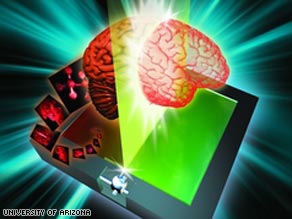
The future of television? This image is an impression of what 3D holographic television may look like.

The future of television? This image is an impression of what 3D holographic television may look like.

It sounds a lot like a wacky dream, but don't be surprised if within our lifetime you find yourself discarding your plasma and LCD sets in exchange for a holographic 3-D television that can put Cristiano Ronaldo in your living room or bring you face-to-face with life-sized versions of your gaming heroes.

The reason for renewed optimism in three-dimensional technology is a breakthrough in rewritable and erasable holographic systems made earlier this year by researchers at the University of Arizona.

Dr Nasser Peyghambarian, chair of photonics and lasers at the university's Optical Sciences department, told CNN that scientists have broken a barrier by making the first updatable three-dimensional displays with memory.

"This is a prerequisite for any type of moving holographic technology. The way it works presently is not suitable for 3-D images," he said.

The researchers produced displays that can be erased and rewritten in a matter of minutes.

To create television sets the images would need to be changing multiple times each second -- but Peyghambarian is very optimistic this can happen.

He said the University of Arizona team, which is now ten-strong, has been working on advancing hologram technology since 1990 -- so this is a major step forward. He believes that much of the difficulty in creating a holographic set has now been overcome.

"It took us a while to make that first breakthrough, but as soon as you have the first element of it working the rest often comes more rapidly," he said. "What we are doing now is trying to make the model better. What we showed is just one color, what we are doing now is trying to use three colors. The original display was four inches by four inches and now we're going for something at least as big as a computer screen."

There are no more great barriers to overcome now, he said.

The breakthrough has made some long-time researchers of the technology believe that it could now come to fruition.

Tung H. Jeong, a retired physics professor at Lake Forest College outside Chicago who had studied holography since the 1960s told NJ.com; "When we start talking about erasable and rewritable holograms, we are moving toward the possibility of holographic TV ... It has now been shown that physically, it's possible."

And what might these holographic televisions look like?

According to Peyghambarian, they could be constructed as a screen on the wall (like flat panel displays) that shows 3-D images, with all the image writing lasers behind the wall; or it could be like a horizontal panel on a table with holographic writing apparatus underneath.

So, if this project is realized, you really could have a football match on your coffee table, or horror-movie villains jumping out of your wall.

Peyghambarian is also optimistic that the technology could reach the market within five to ten years. He said progress towards a final product should be made much more quickly now that a rewriting method had been found.

However, it is fair to say not everyone is as positive about this prospect as Peyghambarian.

Justin Lawrence, a lecturer in Electronic Engineering at Bangor University in Wales, told CNN that small steps are being made on technology like 3-D holograms, but, he can't see it being ready for the market in the next ten years.

"It's one thing to demonstrate something in a lab but it's another thing to be able to produce it cheaply and efficiently enough to distribute it to the mass market," Lawrence said.

Yet, there are reasons to be optimistic that more resources will be channeled into developing this technology more quickly.

The Japanese Government is pushing huge financial and technical weight into the development of three-dimensional, virtual-reality television, and the country's Communications Ministry is aiming at having such technology available by 2020.

Peyghambarian said there are no major sponsors of the technology at present, but as the breakthroughs continued, he hopes that will change.

Even if no major electronics company commit themselves, there is hope that backers could come from outside of the consumer electronics industry, he said.

"It could have some other applications. In training it's useful to show people three-dimensional displays. Also it would be good to show things in 3-D for defense command and control and for surgery," he said.


Read More Add your Comment 0 comments


Categories

Our Partners

© 2010 Virtual Whistler All Rights Reserved Thesis WordPress Theme Converted into Blogger Template by Hack Tutors.info